
Shenzhen, China · 3 years on the factory side

The supplier check a factory quality engineer would run.

I verify Chinese suppliers for overseas buyers — the legal entity, whether they are a real factory, and whether their documents will survive your market. Before you pay.

No account, no charge, no obligation. Looking for a factory rather than checking one? I find it and check it before you pay.

0
In factory quality
Incoming inspection and batch release in Guangdong
0
Suppliers audited on site
Audits I ran myself, not just read about
0
Customer factory inspections
100% pass rate — I was the one being checked
0
SOPs written from zero
Plus 152 record forms, in three languages

Why buyers get burned

Three questions nobody in the chain wants to answer

A supplier list is not the hard part. You can find thousands of listings tonight. These are the questions that actually decide whether your order arrives as specified.

Who is actually on the other side of the contract?

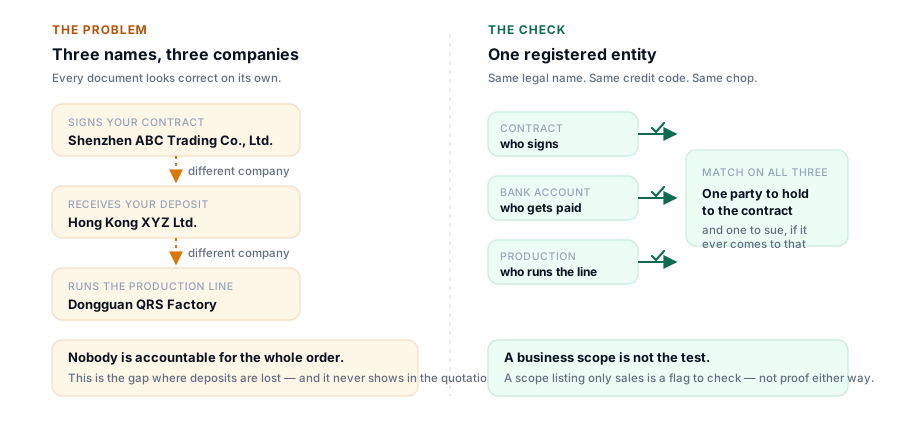
Three entities have to be the same company: the one that signs your contract, the one whose bank account takes your deposit, and the one that runs the production line. When they differ, that gap is where the money is lost — and it never shows up in the quotation.

I compare the registered Chinese legal name, the unified social credit code, the registered address and the company chop across all three — and I report every place they disagree.
Do the certificates actually cover what they are claiming?

A valid certificate for the wrong process is still the wrong certificate. Test reports get passed around between suppliers, with a different material named inside than the one you were quoted.

I check certificate numbers at the issuing body, and compare the report against your quotation.

Will the goods match the file when they ship?

The sample was right. The production run is a different material lot, a changed sub-supplier, a colour that drifted. You find out after the balance has left your account.

I tie the balance payment to QC passing, so the last check happens before the last payment.

What I do

Four ways to work with me

Three fixed-price reports, or a commission on the order. Each one stands on its own — most buyers start with a report on one supplier, then move to the commission once they have a factory worth ordering from.

Report

Supplier verification

Level 1 — the platform screen, price and repeat-rate comparison, and the red flags visible from the desk. Level 2 adds the legal entity, whether it is a real factory or a trading company, capability and QC system for your product, and a clear recommendation — with the evidence behind it.

$49 per supplier What is inside
Report

Compliance document check

For food-contact, flexible packaging and medical device packaging: what your supplier actually holds, mapped against what your market demands, and what is missing.

$99 one supplier, one market What is inside
Report

Multi-supplier comparison

Two or three suppliers, checked on the same criteria and quoted on the same line items — so you can see which one is actually cheaper, rather than which one wrote a shorter price.

$179 2–3 suppliers What is inside
Commission

Sourcing & order follow-up

I question suppliers in Chinese, compare quotations properly, check the sample and the mass production against the same standard, and put your balance payment behind QC passing. The sourcing page covers how I find the factory in the first place.

5–8% of order value How the fee works

Money

Your goods money never passes through me

Two separate payments, on purpose. If something goes wrong with the order, you are not also chasing me for your deposit.

How money moves in an order You pay the factory directly for the goods. You pay Lucas separately for the service fee. Goods money never passes through Lucas. You the buyer Me service fee only Factory paid by you, directly Goods: full price of the order My fee: 5–8% No deposit. No balance. No shipping money. I never hold your funds and take no markup on the factory price.
  • You Factory The full price of the goods, on their own proforma invoice, to their own account.
  • You Me — my fee, 5–8% Invoiced to you after the order is placed with the factory.
  • You Never to me No deposit, no balance, no shipping money, no markup on the factory price.
Two invoices, two accounts. The factory quotes you on their own proforma invoice, in their name, to their account. My fee is a separate invoice to you, issued after the order is placed with the factory.
Money that moves Money that never moves through me

How it works

The eight checks

Nobody honest can guarantee a supplier. "No guarantee" is not the same as "no protection", though. This is what I actually do, in order.

  1. 01Who is actually contracting

    The three entities that must be the same company: the one that signs your contract and stamps it, the one whose bank account receives your deposit, and the one that runs the production line. I compare the registered Chinese legal name, the unified social credit code, the registered address and the company chop — and I report every place they disagree.

    A business scope listing only sales and wholesale is a flag worth checking — not proof. What is registered and what a company can do are two different things.

  2. 02Factory or trading company

    Production address, equipment list, environmental permit, and employee social-insurance headcount — trading companies typically show single digits.

    This is the question that changes the price you are being quoted.

  3. 03Document cross-check

    Certificate numbers verified at the issuing body, not against a PDF someone emailed you. Test reports checked for sample name, date and standard. System certificates checked for validity and scope.

    A valid certificate for the wrong process is still the wrong certificate.

  4. 04Document versus reality

    Is the material named in the test report the material they are quoting you? Are the claimed processes covered by the certificates they hold?

    This is where most of the surprises get caught — before any money moves.

  5. 05On-site check, where I can get there

    Production floor, incoming material area, whether the machines are actually running, inspection room, calibration labels, batch records, finished goods warehouse.

    A visit is not a full audit, and I will not describe it as one.

  6. 06Payment milestones

    Deposit against the proforma invoice; balance tied to QC passing. No pass, no balance. Many buyers do not know this is negotiable. It usually is.

    Your payments always go from you to the factory. I never hold them.

  7. 07Bring in a third party for big orders

    For larger runs I will tell you plainly when to spend your money on a formal inspection by an accredited firm instead of relying on me.

    Saying that costs me the job sometimes. Saying anything else would cost you the order.

  8. 08Put it in writing

    Every quotation, promise and specification change stays in writing — so "that is what we agreed" is never a debate three months later.

    I write spec sheets, technical standards and quality agreements in English and Chinese.

The check that comes first

Are the three entities the same company?

Before you ask what kind of company they are, check who you are actually dealing with. Three entities have to line up: the one that signs your contract, the one whose bank account takes your deposit, and the one that runs the production line. Most of the money that goes missing in China orders is lost in the gap between them — and that gap never shows up in the quotation.

Once those three line up, you can ask the question everybody starts with.

The second question

Factory, or a trading company reselling someone else's product?

This changes the price, the lead time, who can change the specification, and who you can hold to it.

Three different company names behind the contract, the bank account and the production line, compared with all three resolving to one entity.
The check that comes before every other question. On the left, three names and nobody accountable for the whole order. On the right, one entity and one party to hold to the contract.
Three-entity check, then the differences between a trading company and a real factory
What to look at Trading company Real factory
Contract, bank account and production line Three different company names appear across contract, invoice and bank details All three are the same registered entity, and the chop matches
Registered production address Often none registered On file, matching the site you visit
Social-insurance headcount Usually single digits Matches a production headcount
Environmental permit Usually none — nothing is being produced Held for the process they run
The equipment they claim to run Belongs to someone else Theirs, and running when you visit
Who sets the price you receive A margin added on top, invisible to you The maker, on their own invoice
When the specification gets questioned They have to ask the factory first Answered by the people who run the line

Trading companies are not automatically bad — some are efficient and honest. What is not acceptable is paying factory-direct prices without knowing which one you are dealing with.

On the three-entity check, I compare the registered Chinese legal name, the unified social credit code, the registered address and the company chop — and I report every place they disagree. One warning about the obvious shortcut: a business scope that lists only sales and wholesale is a flag worth checking, but it is not proof. Since China's 2021 registration reform, what is registered and what a company can do are two different things.

Sample deliverables

See the report before you buy one

Two real report formats with client-identifying details removed. Every report states what was checked, how, and what could not be verified.

Supplier verification report

PDF · anonymised sample

Legal entity, manufacturer or trading company, capability and QC system, risk notes, and a clear recommendation: proceed, proceed with conditions, or avoid.

Compliance gap check

PDF · anonymised sample

What documents the supplier holds, mapped against what your target market requires, with the gap list and a document request list you can forward as it is.

Where I work

Markets I work with, and the rules that apply in each

Most packaging problems are not manufacturing problems. They are the gap between what a supplier is used to producing and what your market requires. That gap is different in every country, so here is where I am set up to work — and what has to be checked in each place.

United States

  • FDA food-contact requirements — and the fact that there is no such thing as an “FDA certification” for a packaging supplier, so any supplier offering one is worth a second look
  • Country-of-origin marking and CBP entry documentation
  • State-level recycled-content and labelling rules where they apply

United Kingdom

  • UKCA marking and the food-contact framework that replaced the EU rules
  • Extended Producer Responsibility for packaging, including the data you have to report per material
  • Plastic Packaging Tax — the recycled-content threshold that decides whether you pay it

European Union

  • PPWR, the Packaging and Packaging Waste Regulation — recyclability, recycled content and packaging reduction obligations
  • EPR registration in each member state you sell into, because there is no single EU-wide scheme
  • Germany: VerpackG and the LUCID register — you cannot legally place packaging on the German market without registering
  • France: the Triman marking and the French EPR scheme
  • EU 1935/2004 and the material-specific measures behind it, plus the Declaration of Conformity that has to sit in your file
  • Fibre-based composite classification — paperboard and composite are charged at very different EPR rates, and getting it wrong costs money every year

Canada, Australia and New Zealand

  • Canadian federal labelling plus the provincial EPR schemes, which differ by province
  • Australian and New Zealand packaging covenants and the Australasian Recycling Label
  • Country-of-origin and biosecurity requirements for incoming packaging material

Where I am actively taking on buyers right now: the United States, the United Kingdom, Canada, Australia, New Zealand and Ireland.

Where I am set up to work next: the Netherlands, Germany, Sweden, Denmark, Norway, Finland, Austria and Belgium. I work in English, and these are the European markets where that is enough — the buyers tend to work in English, and the packaging rules are the strictest in the EU, which is exactly where a document check earns its fee.

I do not work in French, Italian or Spanish yet. If that is your market, tell me anyway — I would rather say no than pretend.

Before you ask

The three questions that decide it

All 59 answers, grouped the way buyers actually worry, are on the FAQ page.

Q1How do you make money? Do you take money from the factory?

No. I am paid by you, not by the factory.

My fee is 5–8% of the order value, invoiced to you. You pay the factory directly — the money never passes through me.

This matters for one simple reason: if I were paid by the factory, I would have a reason to recommend the factory. I am not, so I do not.

Q8Do I pay you, or do I pay the factory?

Both, separately — and that is deliberate.

  • You pay the factory directly for the goods (their proforma invoice, their account).
  • You pay me separately for my fee (5–8% of the order value).

The reason: your goods money never touches me. If something goes wrong with the order, you are not also chasing me for your deposit.

Q23I already have a supplier. Can you still help?

Yes — that is actually the most common case.

Send me the company name and I will tell you what I can see from here, free. That usually means whether the registered entity matches the name they gave you, whether they present themselves as a manufacturer, and what their registration history looks like.

If you want more than that — an on-site visit, a document check, a compliance gap check — we can scope it from there.

Start here

Start with one company name.

Send me a Chinese supplier you are considering — or one you already buy from. I will tell you what I can see from here, free, and whether there is anything worth paying me to look at.

WeChat QR code for Lucas Yuan
WeChatScan to add me
WhatsApp QR code for Lucas Yuan
WhatsAppScan to open a chat
Shenzhen, China GMT+8 · replies within 24 hours NDA before you send anything

I work as an individual, not through a registered company. If that matters to you, ask — I would rather say it up front than have you find out later.