59 questions buyers ask before they pay
Grouped the way buyers actually worry: first the four traps that cost the most, then the money, my capability, the process, the documents, and what happens after the first order. Nothing here is a promise I cannot keep, and nothing here is a client I do not have.
The four traps buyers fall into most
Sample approved, bulk different. A genuine report for someone else's product. Batch five nothing like batch one. An invoice in a name you never contracted with. Start here.
Q28The sample was approved, but the bulk shipment doesn't match. What could I have done differently — and what do I do now?
First, the pattern. This is the most common complaint in this business, not bad luck. A sample shows what a factory can build once, under conditions it chose. It does not show what the line builds on a normal day.
What is usually missing is one of these three:
- No sealed golden sample, signed and dated, one copy with each side.
- No written acceptance range — what deviation is acceptable in colour, size, registration, weight and seal strength, and what is not.
- The sample came from a sample room, not from the line that ran the order.
What to do now, in this order:
- Do not ship your only approved physical sample back to the factory. Photograph it, weigh it, measure it, and store it dark and dry.
- Collect your written evidence: the approval email or chat, with a date and a version number, plus any photos sent at approval.
- Compare bulk against the approved sample under the same light and with the same instruments, and write each difference down as a number, not as an adjective.
- Send one written notice that states the facts and asks for a position. Keep it factual — "this looks cheap" is not a claim.
- Check what your contract and PO actually say about the standard.
What I can't promise: I am not a lawyer, I do not file claims, and I do not guarantee recovery. Courts have dismissed buyers' claims outright where no sample was sealed, and cut agreed penalties sharply where the sample could no longer be examined. What I can do is fix the evidence set and tell you honestly how strong it is.
Q31The test report is genuine — but is it for my product?
This is the problem I see most often: not a fake report, but a real one that does not cover your goods.
Check four things on the report itself, line by line:
- The applicant — is it your supplier, a resin supplier, or a company you have never heard of?
- The sample name, model and material grade — do they match your order and your specification?
- The lab's accreditation scope — is the specific test method on the report inside the scope, and is the accreditation still valid?
- The date — is it older than the last material change, and inside the validity your market accepts?
Then verify with the lab, not with the paper. China's market regulator publishes a three-step method: check the report number in the official system; check that the body's CMA accreditation is valid and covers each test item; then contact the issuing lab directly.
What I can't promise: I cannot certify that any report is genuine. Two hard limits. CNAS states that to confirm the authenticity of a report you must contact the laboratory itself — its own website only confirms whether a body is accredited. And the national report-number system is filled in by the labs themselves, so a number that cannot be found is a red flag, not a conclusion.
One more thing worth knowing: a US food contact notification is specific to the company that submitted it and to the specified use. An upstream resin maker's notification does not automatically cover the converter's finished bag.
Q37Batch five doesn't look like batch one. Is that "normal batch variation"?
Sometimes it is, and sometimes it is a downgrade with a friendly name. Nobody can tell the difference from a description — only from numbers agreed in advance.
Here is the uncomfortable part: there is no unified standard in China that draws that line. In a 2026 People's Daily investigation, two professors said the same thing — normal variation and a quality downgrade need to be defined, and the test is whether the seller disclosed the change truthfully and completely. Until that is settled, the only thing that protects you is your own specification.
So put this into the PO or its annex, per characteristic: the requirement, the first batch's measured value, the tolerance, the measuring method and conditions, the instrument model, and who decides. At a minimum: colour (ΔE, illuminant, observer, SCI/SCE), grammage and thickness, material structure, print registration, seal strength, total solvent residue, and barrier (oxygen and water vapour).
Two data points explain why this matters. In China's own national spot checks from 2023 to 2025, the failures that recur in films and bags are solvent residue and barrier performance — items a visual inspection cannot see. And in one Qingdao converter's case, a miscalculated curing time put an entire batch over the residue limit; the regulator's fine was about RMB 4,500, while the buyer's loss on the same batch would be orders of magnitude larger.
What I can't promise: I cannot guarantee that a factory will not drift or substitute. What I sell is verifiability, traceability and clause design — a change that happens gets found, and when it is found you have something to point at. And a standard pre-shipment inspection will not catch a different resin, a thinner layer or a changed adhesive: those are not visible.
Q45Which company name should be on my invoice — and does it matter if it's not the factory?
It matters, and it is worth ten minutes before you pay.
In a Chinese export chain, five names can legitimately belong to five different companies: who signs the contract, who makes the goods, who receives the money, who holds the certificate, and who appears on the export declaration. What you want is for the gaps to be documented, not assumed away.
Where it bites:
- US customs: FDA's own "documents required" page lists documentation stating who the actual manufacturer is among the documents it may ask an importer for.
- Invoices: 19 CFR 141.86 requires the invoice to name the seller, the buyer and a responsible employee of the exporter — and requires you to declare assists: goods or services you supplied free or at reduced cost for production, including dies, moulds, tools and engineering work, to the extent not included in the price. For a packaging buyer, that means your artwork, cylinders, plates and moulds.
- Origin paperwork: China's official RCEP filling guide requires the exporter's name to match its registered information exactly, prohibits listing two or more company names, and requires the invoice number and date to match the invoice used at import clearance.
- Payment: if the account holder is not the party you contracted with, your bank may question the payment — and your position weakens.
So the check is not "is this a factory". It is: are the contracting entity, the receiving account and the production entity the same company — and where they are not, is there a written explanation that survives a customs question?
What I can't promise: I cannot tell you a structure is fine because the names differ — some differences are normal and legal. I report where the names disagree and what kind of question each disagreement invites. I am not a customs broker and I do not file anything for you.
Trust & conflicts of interest
This is the section that decides whether we work together. I would rather answer it before you ask.
Q1How do you make money? Do you take money from the factory?
No. I am paid by you, not by the factory.
My fee is 5–8% of the order value, invoiced to you. You pay the factory directly — the money never passes through me.
This matters for one simple reason: if I were paid by the factory, I would have a reason to recommend the factory. I am not, so I do not.
Two things I want to separate clearly:
- Order management is commission-based (5–8% of order value), because the work scales with the order.
- Everything else is a fixed price, paid by you, and never contingent on an outcome. That includes recoverability assessment work: my fee never depends on whether money is recovered, and I never take a percentage of a recovery. If a percentage-of-recovery arrangement is what you need, that has to be a licensed Chinese law firm, not me.
I do not collect, hold, transfer or advance any third-party fees — court fees, lawyer fees, notary and apostille fees all go from you directly to the court or the firm.
Q2You are paid by me — so how do I know you are not taking a kickback from the factory on the side?
You do not have to take my word for it. Here is what you can check:
- The factory quotes you directly. I do not relay prices and I do not mark them up. You see the factory's own proforma invoice, in their name.
- My fee is a fixed percentage, disclosed in writing before we start. It does not change depending on which factory you choose.
- I never hold your money. Every payment goes from you to the factory, or through an escrow or platform you control.
Q3What stops me from contacting the factory directly and cutting you out?
Nothing — and you should assume it is possible. So let me be straight about how I work:
What I do not sell: a phone number. A factory contact is worth almost nothing on its own. You can find thousands of them on Alibaba tonight.
What I actually sell: I run the order. That means:
- I check the factory before you pay
- I stand between you and the factory, in Chinese, on your side, for the whole order
- I check the goods against your spec before the balance payment goes out
- I chase the things you cannot chase from 8,000 km away: the real production date, the sub-supplier they quietly switched, the spec they changed without telling you
One policy I will state up front, so there is no surprise later: I do not hand over a supplier's contact details until an order is confirmed. That is not hiding anything — it is how every sourcing agent protects their work, and it is the same reason a recruiter does not send you their candidate list before you sign. Once the order is confirmed, you deal with the factory directly on everything — invoice, production updates, shipping.
And practically: most buyers find that running the coordination themselves costs more than my fee. If you would rather take it in-house after the first order, that is your call — I would rather earn your second order than trap you in your first.
Q4Will you approach my suppliers behind my back, or sell my supplier list to someone else?
No. Two things protect you here:
- I sign an NDA before you send me anything — I can send you a simple one-page mutual NDA, or sign yours.
- I do not work for your competitors in the same product category. Tell me who they are and I will confirm in writing that I will not take them on.
Practically: my business only works if buyers trust me with their supplier lists. Breaking that ends it in one week.
Q5Do you work for the factory side too? Who is your client?
Only the buyer. I do not take commissions from factories, I do not represent factories, and I do not do "supplier introductions for a fee" from the Chinese side.
My only client is the person paying me — the buyer.
Q6I have never hired anyone in China before. How do I know you actually exist?
Fair question. Here is what you can verify:
- Legal status: I work as an individual, not through a registered company. I am not going to pretend otherwise — it is the kind of thing that is found out in one search. What that means for you in practice: an English-language invoice from me personally, not a corporate invoice, and no Chinese VAT invoice (fapiao).
- LinkedIn: linkedin.com/in/lucas-yuan-qa — with my real work history.
- Website: lucas-yuan.com — registered to me, with a business email, not a Gmail address.
- Video call: I am happy to do a 15-minute call before you commit anything. Ask me and I will turn my camera on.
If you want, I will do a 15-minute video call and show you my ID, and my real name appears on every invoice. A supplier's sales rep is often not authorised to sign anything — I would rather be the opposite of that.
I would rather you check than assume.
Money & payment
Who gets paid, when, and what document you get for your accountant.
Q7How do I pay you?
Five routes, in rough order of what most buyers prefer:
- Payoneer — I invoice you through Payoneer, and you pay by card or bank transfer in USD/EUR/GBP. Fastest for most buyers.
- WorldFirst — if you already use it for Alibaba.com or AliExpress payments, we can keep the payment there.
- Wise — useful if you are in Europe and want the exchange rate and the fee shown before you send.
- Bank transfer (T/T) — I can provide USD account details. Good for larger amounts.
- Platform escrow — if you would rather pay through Upwork or Fiverr, we can run it there (their fees apply).
I never ask you to send money to a personal Chinese bank account with no paper trail. Account details are only ever sent inside an invoice — never pasted into a page or a chat message.
The full picture — which payment goes where, when each one falls due, and what the invoice contains — is on how payment works.
Q8Do I pay you, or do I pay the factory?
Both, separately — and that is deliberate.
- You pay the factory directly for the goods (their proforma invoice, their account).
- You pay me separately for my fee.
The reason: your goods money never touches me. If something goes wrong with the order, you are not also chasing me for your deposit.
Q9When do I pay your fee?
Two different things, two different rules:
- Commission work (sourcing and order management): invoiced after the order is placed with the factory. Not before. If I do not find you a factory worth ordering from, you do not owe me anything.
- Fixed-price written work (reports, document checks, assessments): agreed up front, invoiced on delivery. This work is priced on what I deliver, not on what happens afterwards.
I do not offer, and will not accept, any arrangement where my fee depends on recovering money or winning a case. That is not modesty — in China it is the specific fact pattern courts treat as fraud.
Q10Can you issue an invoice or receipt for my accounting?
Yes. I issue a proper English-language invoice (PDF) with:
- My business name and address
- Invoice number and date
- Description of service, amount, currency
- Payment details
That is the document your accountant needs. I do not issue Chinese VAT invoices (fapiao) — buyers almost never need them, and they require a registered Chinese company. If you specifically need one, tell me in advance and I will say honestly whether I can arrange it.
Q11What are your rates? Do you charge hourly?
Two ways, depending on what you need:
1. Commission (for sourcing and order management)
5–8% of the order value. Charged only after the order is placed with the factory.
2. Fixed-price written reports
- Supplier verification report — $49
- Compliance gap check — $99
- Multi-supplier comparison — $179
I do not bill hourly. You should know the cost before we start, not after.
Capability & limits
What I can do, what I will not pretend to do, and why that is useful to you.
Q12What exactly can you do — and what can you not do?
What I do:
- Verify a supplier's legal entity and whether they actually own a factory
- Check whether their certifications and test reports will hold up in your market
- Source alternative suppliers in Guangdong (1688 and factory-direct)
- Compare quotations on price, MOQ, lead time and payment terms
- Check packaging and labelling compliance for food-contact, medical device and general consumer goods
What I do not do:
- I am not a certification body or a testing lab. I read documents and check factories; I do not issue certificates.
- I do not guarantee a supplier. I can tell you what I found and what I could not confirm.
- I do not handle your money, your deposits or your shipping.
- I am not a lawyer, and my compliance checks are a gap check, not legal advice. And I cannot act as your litigation representative in China: foreign parties in Chinese court proceedings must be represented by a licensed Chinese lawyer. I help you choose one, brief one and manage the case — I do not stand in for one.
- I do not do full third-party inspection (PSI) with AQL reporting on a mass-production run unless we agree it separately.
- I do not provide debt collection, and I will not refer you to a collection agency. That business model itself carries criminal exposure in China.
- I never promise an outcome, and I never offer a refund if an outcome is not achieved. If someone offers you that, do not sign it.
Q13Can you do an on-site factory visit?
Yes — I am based in Guangdong and can visit suppliers in the Pearl River Delta (Guangdong, and Fujian or Zhejiang with travel arranged).
Important: an on-site visit is not the same as a full audit. On a visit I check what is visible — production floor, incoming material area, equipment actually running, records on hand, warehouse. I will tell you exactly what I saw and what I could not verify.
If you need a formal third-party audit with a full checklist and scoring, I will tell you honestly that you should hire an accredited inspection firm instead.
Q14Have you done this for other buyers before?
I have been on the receiving end of this — six customer factory inspections, all from the factory side. I was the person who had to satisfy them: walk them through the line, hand over the documents, answer the questions they flew 8,000 km to ask.
That is the side of the table I have been on for three years: incoming inspection, batch release, on-site quality audits at four core suppliers, ISO 9001 / 13485 / 14001 / 45001 built from zero.
So I know what buyers check — because I have been checked. What is new is offering it as an independent service.
If you want to test me cheaply: send me two names — the supplier's name, and the company name that appears on your proforma invoice. I will tell you, free, whether those two are the same legal entity. That single gap is where most of the money gets lost, and it takes me ten minutes.
What I cannot tell you from a desk is whether they run the line that makes your product. That is a different job, and I will tell you honestly whether it is worth paying for at your order size.
Q15You do not know my product. How can you judge a supplier for it?
You are right that I do not know your product as well as you do. That is not what I am checking.
I check the things that do not depend on knowing your product:
- Is this a factory or a trading company?
- Do their certificates actually cover the process they are claiming?
- Is the material they described the material in the test report?
- Do their own records match what they told you?
For product-specific judgement, I will ask you for the spec and check the supplier against your spec — not against my opinion.
Q32My supplier says they have "FDA certification". Is that a real thing?
For food-contact packaging, no — not in the sense the certificate suggests.
FDA's own words: food facilities do not need a certificate of registration; FDA does not issue a certificate of registration or product status; and FDA does not recognise a certificate of registration or product status issued by a private business. FDA also reminds issuers that the FDA logo is for official FDA use only. Registration is free, and FDA is not affiliated with the businesses that sell "registration".
What actually exists — and what to ask for instead:
- The specific authorisation for the substance and the use: a food contact notification number, a food additive regulation in 21 CFR, or a Threshold of Regulation exemption.
- Whether that authorisation covers the finished article you are buying, not just the resin.
- A letter of guaranty — the document with legal weight for a US buyer. Note the form requirement: where the shipment is from a foreign manufacturer, 21 CFR 7.13(d) requires the guaranty to be signed by that manufacturer and by an agent of that manufacturer who resides in the United States.
What I can't promise: I cannot get you an "FDA certificate", because the thing does not exist in that form. And I cannot guarantee that a complete document set keeps customs or a market regulator off your shipment. Documents are necessary, not sufficient.
Q58If something goes wrong, what can you actually do — and what will you refuse to do?
What I do, within my limits:
- Assess whether the money is worth pursuing: what the evidence shows, who the counterparty is, and what a claim would realistically cost.
- Put the evidence in order: the contract, the PO, the approvals, the payment record, the correspondence, the inspection and test records — with dates, and a Chinese translation of the key documents.
- Give you a route opinion, not a case opinion: report to the police, or sue, and why, based on the facts.
- Help you select and brief a licensed Chinese law firm, and compare fee structures.
- Send letters that you sign — demand letters, and anything that preserves a limitation period.
What I refuse:
- I am not a lawyer, and I will not act as your litigation representative in China. Foreign parties in Chinese court proceedings must be represented by a licensed Chinese lawyer.
- I do not provide debt collection, and I will not refer you to a collection agency. A business that only made phone calls to chase lawful debts has been convicted of illegal business operation in China.
- I never promise an outcome, and I never offer a refund if an outcome is not achieved. Courts have treated "I'll get it back or your money back" as evidence of fraud — in one reported case, a seven-month prison sentence.
- I do not take a percentage of what is recovered. If that is what you need, it has to be a licensed Chinese law firm.
Two numbers to hold in mind. In 2025 the Supreme People's Court reported an enforcement-in-place rate of 50.59% and a fully-enforced rate of 39.29% across all cases. And on a USD 100,000 claim, the hard up-front costs — court fees, legal fees, translation, notarisation and apostille — can easily reach 15–30% of the amount claimed.
What I can't promise: I cannot promise recovery, and I cannot predict how a court will rule. My value here is judgement and evidence, not muscle.
Process & timing
What happens, in what order, how long each part really takes, and what to do when a date slips.
Q16What is the process, and how long does it take?
Typical sourcing timeline (depends on your product):
| Stage | Typical time |
|---|---|
| Requirement clarification | 1–2 days |
| Supplier search & shortlist | 3–10 days |
| Quotation comparison | 2–5 days |
| Sampling & confirmation | 2–8 weeks |
| Production | 4–12 weeks |
| QC & shipping | 2–8 weeks |
Two things buyers most often underestimate: sampling takes weeks, not days (first samples rarely pass on the first round), and shipping is not instant.
Q17What is the time difference? How fast do you reply?
I am in GMT+8 (China Standard Time) — 12 hours ahead of US Eastern, 7–8 hours ahead of Europe.
What you can expect:
- Emails: reply within 24 hours, and usually within a few hours during my working day
- WeChat / WhatsApp: same
- Video calls: I will book a slot that works for your time zone, including evenings my time
Q18Can you communicate in English?
Yes — all of my written work is in English. My spoken English is conversational, not native, so if we do a video call, I may speak a little slowly and I may ask you to repeat something.
I would rather say that up front than have you find out on the call.
Q50How far ahead do I really need to plan around Chinese New Year?
Further than the holiday itself suggests. The public holiday is about a week to nine days; the disruption is not.
A carrier's own guidance is blunt: factories typically reduce output two to three weeks before the holiday and may not resume full capacity until mid-March, and the ripple effects on logistics can last up to six weeks. Carriers also cancel sailings — for Chinese New Year 2026, one line cancelled fifteen voyages across several services.
For 2027 the fixed date is Chinese New Year's Eve on Friday 5 February 2027, with the nine-day holiday rule applying.
What I do with that: a backward calendar with five written milestones — last order date, material confirmation date, completion date, inspection window, and cargo-ready-to-carrier date — with the balance payment tied to the same table.
What I can't promise: I cannot make a factory faster, and I will not promise on-time delivery. In April 2026 the industry-wide schedule reliability figure was 62.4%, with an average delay of 5.34 days; the least reliable major carrier was at 39.6%. What I can do is put the real dates in writing, watch them, and tell you early when a milestone slips. I also will not quote you a percentage of buyers who suffer delays — I found no first-hand statistic for that.
One warning from experience: do not pay for a "Chinese New Year guarantee". Carriers cancel sailings, and a supplier cannot overrule that.
Q51My supplier says "no problem". How do I know when to actually worry?
Because of one assumption gap. In China sourcing, the working rule is "no news = bad news"; for most Western buyers the default assumption is "no news = good news". That line comes from a bilateral chamber of commerce's own guidance, and it is the single most useful thing I can tell a first-time buyer.
So build the news instead of waiting for it. Put a written update at fixed checkpoints into the order terms — material in, start of production, completion, inspection, cargo ready — and say what happens if an update is missed. I send the update; you do not have to chase it.
Two patterns from buyers' own accounts are worth recognising. First, delay attributed to the destination customs: a buyer messaged the supplier almost daily while being told Canadian customs was simply slow and the goods were held for inspection — part of the shipment never arrived. Second, the explanation that arrives late and changes the plan: a contract for rail freight, shipped by sea instead, with a 41-day delay and the sales season gone. In both cases the buyer was not short of messages. The buyer was short of accurate ones.
What I can't promise: I cannot make a factory tell the truth, and I will not pretend I can. What I can do is raise the frequency and cross-check the content — dated production photographs, container and booking numbers, the documents that should exist at each stage — so that a false statement has to be maintained over time rather than said once. And I will not read every silence as a problem: no statistic exists on how often silence means trouble.
Also from the same source, and worth acting on: the chamber's guidance says it is impossible to manage China operations from a distance, and recommends visiting suppliers at least once a year.
Q52Will my order get pushed to the back because a bigger customer came in?
Probably, if it can be — so plan for it rather than be surprised by it. Capacity is finite, and the orders that keep their slot are the ones with a committed payment schedule and a fixed date.
What reduces the risk, in order of effect:
- A production slot agreed in writing, with a date — not a lead time in weeks from an unstated start.
- A deposit that arrives on time. Late deposits are the most common legitimate reason a slot gets given away.
- Milestones with consequences: if a date slips, the new date and its effect on shipping are stated in writing.
- A balance held until inspection passes, which gives you something to withhold if the plan is not kept.
I also tell buyers when the order is too small to command a line. In that case the honest options are to accept longer lead times, pay for a firmer slot, or use a supplier whose line fits your size.
What I can't promise: I cannot get you priority over a bigger customer, and I cannot make a factory reserve capacity it has not agreed to. I also will not pretend to have statistics on how often small orders get bumped — I do not. What I can do is get the slot in writing and tell you early when the plan changes.
Q53When is the safest time to pay the balance?
There is no payment method that is safe. There is only a payment schedule that keeps your leverage until the goods are verified.
The structure I recommend: deposit against the proforma invoice; balance released only when the goods have passed inspection and are packed and ready. Not when they are "nearly ready", and not against a photograph of a pallet.
Why this matters: once money has left your account, the practical routes to get it back are weak. An EU-funded guide for SMEs says plainly that once an advance payment has been made, if anything goes wrong it is impossible to get the prepayment back without legal action. And platform protection is smaller than most buyers assume: under the platform terms I could verify, late-delivery compensation is 10% of the actual order value with a maximum of US$100, paid as coupons, and one claim per order — and paying outside the platform, by wire transfer for example, voids the protection entirely.
Two rules I apply: never send money to an account that is not the party you contracted with, and never to a personal account. And decide before you pay what you will do if the balance is paid and the goods are wrong.
What I can't promise: I never hold your money, I never act as escrow, and I cannot recover a payment. I do not guarantee that a factory will refund anything. What I do is check the receiving account against the contract and the registration before you send, and write the release condition into the order.
Q54My shipment is late. Who pays for what — and what can I actually claim?
Work through four questions.
1. Was the delay in production, or in transit? They have different remedies and different evidence. Production delay is a contract issue with the factory. Transit delay is a carrier issue — and the industry baseline tells you how normal late is: 62.4% schedule reliability in April 2026, average delay 5.34 days.
2. What did the contract say about the transport mode and the date? A switch from the agreed mode to a slower one is a breach you can document. One buyer's account is exactly this: contracted rail, shipped by sea, a 41-day delay and a missed season.
3. What is accruing while the goods sit? Detention and demurrage are charged from the end of free time, and the importer is liable even when the delay is not the importer's fault. That is a commercial fact of the port, not a penalty you can argue away — which is why the free-time clock belongs in your planning.
4. What does your platform or payment protection actually pay? Read the clause, not the marketing. In the terms I could verify, the ceiling is far below the value of a normal order.
What I can't promise: I cannot guarantee an outcome, and I cannot file a claim for you. I will not quote a shipping rate or a demurrage rate as if it were standard — the figures I found came from a forwarder's explanation and one logistics provider's own estimates, not from an official tariff. What I do is keep the documents that show what happened, which is what any claim or negotiation is built on.
Documents, compliance & liability
What each market requires, who is responsible for it, and where your information stays.
Q19Will you keep my information confidential?
Yes. I can sign your NDA, or send you mine. Standard terms I work under:
- Your supplier list, specs, prices and product plans stay confidential
- I will not contact your existing suppliers without your written approval
- I will not use your project as a public case study unless you approve the wording
If you need me to work under your company's NDA template, send it — I will review and sign.
Q20Can you guarantee the supplier will not cheat me?
No, and nobody honest can.
But "no guarantee" is not the same as "no protection". Here is exactly what I do, in order:
| # | What I do | How |
|---|---|---|
| 1 | Who is actually contracting | The three entities that must be the same company: the one that signs your contract and stamps it, the one whose bank account receives your deposit, and the one that runs the production line. I compare the registered Chinese legal name, the unified social credit code, the registered address and the company chop — and I report every place they disagree. |
| 2 | What the registration does and does not prove | I do read the business scope — but as one input, not a verdict. A scope that lists only sales and wholesale is a flag worth checking — it is not proof. Since China's 2021 business-scope registration reform, what is registered and what a company can actually do are two different things. A court has held that a bidder who added "manufacturing" to its scope on the day of the bid still had manufacturing capability. Registered address, social-insurance headcount, equipment ownership and production records are cross-checked against each other instead. |
| 3 | Document cross-check | Certificate numbers verified at the issuing body; test reports checked for sample name, date and standard; system certificates checked for validity and scope — not just the PDF. |
| 4 | Document vs. reality | Is the material in the test report the material they are quoting you? This is where most "surprises" are caught before money moves. |
| 5 | On-site check (where I can get there) | Production floor, incoming material area, whether the machines are actually running, inspection room, calibration labels, batch records, finished goods warehouse. |
| 5b | Change notification | Nothing gets substituted quietly. Any change of material, process, or sub-supplier must be approved in writing before production — a verbal "same as last time" does not count, and the obligation extends to their own suppliers. |
| 6 | Payment milestones | Deposit against the proforma invoice; balance tied to QC passing — no pass, no balance. |
| 7 | Bring in a third party for big orders | For larger runs I will tell you plainly when to spend the money on a formal accredited inspection instead of relying on me. |
| 8 | Put it in writing | Every quotation, promise and spec change stays in writing — so "that is what we agreed" is never a debate. |
Two limits I want to be explicit about:
- Any remote check has limits. I can confirm documents and public records. I cannot see inside a production run from a desk.
- I am not a certification body, a testing lab, or a lawyer. I find gaps; I do not issue certificates or give legal opinions.
If someone tells you they can guarantee a supplier 100% from behind a desk, that is a sales line, not a professional answer.
Q21What if the supplier turns out to be bad — who is liable?
I am not liable for the supplier's performance, and I say that up front. My deliverable is information: what I found, what I verified, and what I could not.
Every report includes a clear statement of:
- What was checked and how
- What could not be verified
- What the report is not (not a certification, not a legal opinion, not a guarantee of future performance)
If you need contractual protection, that sits between you and the factory — and I will tell you when a clause is worth pushing for.
Q43Which documents do I actually need — and how does that change for the US, the EU and the UK?
The list is different per market, and the responsibility for most of it is yours, not your factory's. This is the working version I use.
EU, food-contact packaging:
- A declaration of compliance for the finished article, meeting the content requirements of EU 10/2011 Annex IV — including NIAS disclosure, the intended food types, contact time and temperature, and the verified surface-area-to-volume ratio.
- Migration test evidence for the actual article, at your real conditions.
- Where relevant: the BPA restrictions under (EU) 2024/3190 — which apply to printing inks and adhesives as separate categories — and the PFAS limits for food-contact packaging.
- Packaging waste obligations sit with the producer in each member state where the packaging becomes waste.
UK: EPR registration and data reporting if you cross the thresholds; Plastic Packaging Tax if your plastic packaging components reach 10 tonnes and use less than 30% recycled content; plus the product rules that apply to the goods themselves.
US: no federal packaging EPR. At federal level the food-contact question is about authorised substances, plus a letter of guaranty; import documentation must identify the actual manufacturer; and state programmes exist (California, Colorado, Minnesota) with their own registration and reporting duties.
What I can't promise: I do not give legal opinions and I do not certify compliance. Two limits I state up front: I have not verified Amazon's requirements from Amazon's own documents, so I will not quote them as fact; and my depth is packaging and food-contact materials — not medical devices, electronics or toys. Where I don't know, I say so.
Q44Who is legally responsible for the DoC — me or the factory? Can my supplier sign it?
For food-contact materials in the EU, the answer is you — the importer, or the business placing the product on the market.
Ireland's food safety authority puts it plainly: if you import these food-contact materials into the EU, you are responsible for issuing a DoC for them. Finland's says every operator in the chain must provide a DoC to the next operator — manufacturer to importer, importer to distributor. France's DGCCRF line is the same: the guarantee comes from those responsible for placing the product on the EU market.
So what is a factory's DoC worth? It is real evidence about the material the factory supplied, and you need it. It does not discharge your own obligation, because what you place on the market is the finished printed and laminated article — and printing, laminating and bag-making change the material.
A DoC also has a shelf life. Finland's guidance says it must be updated at least every three years, and must be updated when composition or purity changes in a way that affects the declaration, with a duty on the supplier to notify you. The French position allows up to five years provided nothing changes the inertness of the material. Recycled plastic declarations must be batch-specific.
What I can't promise: I do not sign or issue a DoC. I am not you, and I am not your EU responsible person — signing one would convert your legal obligation into my forgery risk. What I do is check the one you have against the required content, line by line, and tell you what is missing.
Q46Which missing document is most likely to stop my goods at customs?
From the cases and rules I have read, four candidates, in this order.
1. The Importer of Record record. If you buy on DDP terms and have never checked whose name, address, email and phone are on the importer record, that is your biggest exposure. Since 18 September 2026, US CBP can immediately void an IOR number when the information on CBP Form 5106 is inaccurate or incomplete. The physical address cannot be a registered agent, customs broker, freight forwarder, P.O. box or business service centre, or another person's address; the email and phone must belong to the IOR; and the broker's power of attorney must be executed directly with the IOR, not through a forwarder. The notice goes to the email on file — which may be the wrong one.
2. Wood packaging. Solid wood packing from China has its own US rule, and inaccurate documents can mean refusal of entry. On the import side into China, missing or absent IPPC marking attracts penalties — with a higher penalty band when there is no IPPC mark at all — while plywood, particle board, fibreboard and thin-board packing is exempt.
3. The DoC and test evidence for food-contact goods, including the EU rule requiring a declaration of compliance and laboratory reports to be sent 48 hours in advance for polyamide and melamine plastic kitchenware from China and Hong Kong, with a documentary check on all consignments.
4. Origin and value consistency. Invoice, certificate of origin, bill of lading and the destination entry have to tell one story — and the bill of lading in your hand may not be the set used for the export declaration.
What I can't promise: I am not a customs broker and I do not clear goods. I cannot tell you your shipment will not be examined, and I will not quote you a detection rate — no official examination-rate data is published. What I do is check that the facts on your documents are the same facts, before the goods move.
Q47Who is the Importer of Record on my entries — and whose address is on the form?
Ask this question before your next shipment, not after.
Under DDP, the seller arranges delivery through customs — and in practice that often means the importer of record is the supplier, or a forwarder acting for them, with the forwarder's contact details on the record.
Since 18 September 2026, US CBP's notice states that inaccurate information may result in immediate voiding of IOR numbers. The specifics are strict: the physical address must be the actual location of the business or individual, and cannot be a registered agent, customs broker, freight forwarder, P.O. box, business service centre or another person's address; the email must belong to the IOR, and third parties may not substitute their own; and customs brokers must execute the power of attorney directly with the IOR. The notice is sent to the email the IOR last submitted. CBP also flags that inaccurate or misleading information on Form 5106 is material to an obligation to pay money to the government.
Three questions for your broker: who is the IOR on my last five entries; if customs visited the address on my Form 5106, would they find my business operating there; and which mailbox will receive a notice like this.
What I can't promise: I am not a customs broker and I do not file entries. I will not tell you whether DDP is safe or unsafe — it depends entirely on the structure. And if you discover that a past declaration was inaccurate, my advice is not to correct it first: ask a customs lawyer in the destination country about the right order of steps, because a correction can itself create new exposure.
Q48What do I need to prepare for EPR, the UK Plastic Packaging Tax, and PFAS?
Three different things, three different triggers.
UK Plastic Packaging Tax. The rate is £228.82 per tonne from 1 April 2026, and you register if you manufacture or import 10 tonnes or more of finished plastic packaging components in a 12-month period. A component is exempt where recycled content is at least 30% of the plastic in it. The burden of proof is on you, the taxpayer: all plastic is assumed to be virgin unless there is evidence otherwise. And from 1 April 2027, pre-consumer waste — factory offcuts and regrind — will no longer count as recycled plastic for this purpose. So "our film contains 30% recycled material" stops working as an answer.
UK EPR. Obligations depend on establishment, tonnage and turnover: no obligation below 25 tonnes; small producers register and report but do not pay disposal fees or buy PRNs; large producers pay disposal fees and must complete a recyclability assessment that rates packaging red, amber or green — which is what sets the fee. The published 2025 base rates include plastic at £423 per tonne and fibre-based composite at £461 per tonne. Missing information scores as red. The data you must report is per packaging component, per material, in kilograms — which most Chinese quotations do not contain.
PFAS. For food-contact packaging placed on the EU market, PPWR limits apply from 12 August 2026: total PFAS ≤ 50 ppm, individual PFAS ≤ 25 ppb, and the sum of PFAS ≤ 250 ppb, with a three-step screening and targeted-analysis method published by the Commission. Anti-grease papers, coatings and some inks are where the question lands — and many factories cannot answer it, because their ink is bought in.
What I can't promise: I do not file your EPR returns, I do not calculate your tax, and I do not sign anything on your behalf. Some of these figures are illustrative rather than final rates, and rates change annually — I will date every figure I give you. What I do is get the per-component material and weight data out of the factory, in a form your compliance provider can use.
Q49How do I check whether an ISO 9001 certificate is real, valid, and actually covers what I'm buying?
Three checks, in this order.
1. Is the certification body real, and still approved? Certificates can be withdrawn after they are issued. China's accreditation body has published a penalty revoking a certification body's approval and declaring a specific quality-management certificate it issued invalid. Status is a moving thing, not a fixed fact.
2. Is the certificate still valid, and what does its scope say? Check it in an official database — IAF CertSearch for management-system certificates, NANDO for EU notified bodies where CE is involved. Then read the scope against what you are buying, the process and the site. A valid certificate whose scope covers a different product, process or address has not answered your question.
3. Who is claiming what? ISO does not perform certification and does not issue certificates; a company cannot be certified by ISO. Certification is performed by external bodies. So "ISO certified" is never a statement about a batch of goods.
What I can't promise: I cannot certify a certificate, and I will not treat ISO 9001 as a quality guarantee — it is a system certificate, and it says nothing about whether any particular batch conforms. One buyer's public account describes exactly this pattern: certification bodies that were on the EU database but not approved for the directives required, or not on it at all, while the supplier insisted it had exported to Europe before.
Getting started & ongoing follow-up
How to begin, and what continuing looks like after the first order.
Q22I do not have a supplier yet. Where do I start?
Start with one thing: tell me what you are buying.
Send me:
- The product and the spec (or a photo)
- Target quantity and target price if you have one
- Which market you are selling into (this drives the compliance requirements)
I will come back with the two or three things that will actually decide whether this works — usually MOQ, the compliance documents, and whether your target price is realistic.
If you want to see how the search itself works before you send anything, it is written out step by step on sourcing — find a factory.
Q23I already have a supplier. Can you still help?
Yes — that is actually the most common case.
Send me two names: the supplier's name, and the company name that appears on your proforma invoice. I will tell you, free, whether those two are the same legal entity. That single gap is where most of the money gets lost, and it takes me ten minutes. (Same free check as Q14 — one check, not two.)
What I will not do is guess from a registration record. A registration tells you who a company is. It does not tell you what it can produce — and I will say so even when that costs me the job.
If you want more than that — an on-site visit, a document check, a compliance gap check — we can scope it from there.
Q55Is one inspection enough — or does this have to happen every order?
One inspection is one photograph of one moment. It tells you what the shipment looked like on the day someone looked at it. It does not tell you what the next batch will look like.
What carries across batches is the written standard: the sealed golden sample, the specification with tolerances and measuring conditions, the change-notification clause, and the batch records. What has to be repeated is verification — against those documents, not against memory.
A practical schedule for a repeat order:
- Every batch: batch number, key measured values, retained sample, production record.
- Every batch before the balance: inspection against the agreed limits.
- Periodically: targeted testing on the items that drift — solvent residue and barrier for films, colour for printed work.
- Every time something changes: material grade, resin, adhesive, ink, substrate source, grammage, process parameters, subcontracted operation or production site — declare it, approve it in writing, then verify it.
What I can't promise: I cannot guarantee that the second batch matches the first, and I will not sell "one check, permanently valid". Even in regulated systems a declaration of compliance has a validity period — one authority's guidance says update at least every three years, with earlier updates when composition changes. If a document has an expiry, an inspection certainly does.
Q56You checked the supplier once. Will you still be involved in the batches after that?
That is your choice, and it should be priced as a choice — not as an implied lifelong obligation.
Three shapes it can take:
- One-off: the verification report before you pay. It stands on its own, and I do not pretend it covers the future.
- Per batch: I check the documents and the numbers each time, and I tell you whether the batch is inside the agreed limits.
- Ongoing: a written update at each milestone, change notices logged, and a short monthly note on what changed at the supplier — status, certificates, and any document that has expired or is about to.
What I will not do is let the first report quietly become the basis for trusting everything afterwards. A check has a date on it.
What I can't promise: I am not liable for a supplier's performance. My deliverable is information: what I found, what I verified, and what I could not. If a supplier goes bad later, that is between you and them — I will tell you what evidence we have and where it is weak.
Q57How does change notification actually work in practice?
It works as a form and a date, not as a promise.
The clause says what may not change without written approval: material grade, resin, adhesive or ink supplier, source of substrate, grammage, process parameters, subcontracted operations, production site. It says that verbal approval is not valid. It says the obligation reaches the factory's own suppliers. And it sets the lead time for a request — one car maker's standard requires change requests at least 12 weeks before introduction, which tells you the scale of a real approval process.
In practice, each proposed change comes with a one-page form: what changes, from what to what, why, which batches are affected, what evidence is attached, who signs. One copy for the factory, one for you, and I keep a log with the date.
The part that makes it real is what happens when a change is not declared: the goods can be rejected, and the cost position changes. Without that, the clause is a courtesy.
What I can't promise: I cannot detect every change a factory makes. What I can do is make declarations auditable — the records that should exist for each declared change, checked against the physical goods at the points where I can see them. And I will not tell you that a factory never changes anything; every factory does.
Q59What do I get to keep at the end — and how long do you keep it?
You keep everything, and you should own it from the start.
What I hand over: the report with its evidence list and its limits, the signed and dated sample records, the written specification and clause pack, the inspection records, and the correspondence log with dates. The files are yours; I do not hold your documents hostage, and I do not reuse your project as a public case study without your written approval.
What I keep for continuity: the change log for each SKU, the batch history, the documents I verified with the dates I verified them, and the list of dates on which those documents expire. That last list is where suppliers get caught — a declaration or a certificate that was valid when you started is often not valid two years later.
Retention beyond that is your call. I will tell you what I recommend keeping and for how long, based on the market's rules rather than on my convenience.
What I can't promise: I cannot promise that a document that was valid stays valid. Registration status, accreditation and declarations all change, and I have found published cases where an accreditation was withdrawn and a certificate was declared invalid after the fact. If you want me to keep watching those statuses, that is ongoing work and it is priced as such.
Samples
What is free, what is not, which sample you are actually approving, and who owns the tooling.
Q24Do I have to pay for the sample, and will the sample fee be credited against my first bulk order?
Usually yes, you pay — and whether it comes back depends on what was agreed, not on what the sales rep said.
Three arrangements are normal, and none of them is "the standard":
- Stock sample: often free, you pay the courier.
- Custom sample: charged, and sometimes credited against the first bulk order once it reaches an agreed volume.
- Tooling, printing plates, hot-stamping dies, cutting dies, inserts: one-off start-up costs. These are normally not credited, and they are normally not included in the unit price.
Two things I check for you:
- Whether "free" is real. Compare the unit price in a "free sample" quote against a quote that charges for the sample separately. Free samples are sometimes paid for in the unit price.
- Whether the credit condition is written. What volume triggers the credit, when it is paid back, and what happens if you order less.
What I can't promise: I cannot promise you a free sample or a refunded sample fee. That is the factory's commercial decision. What I can do is get the condition in writing before you pay.
If the courier cost is the problem — it often is — ask to use your own courier account. One buyer was quoted $50 to ship a sample weighing under 1 kg, and compared it with a supplier in Poland that charged $15.
Q25Is it normal that the sample is free but I pay the courier?
Normal — for standard products it is the most common arrangement. Fully free, product and shipping, is the exception rather than the standard.
What is not normal is finding out the freight cost after you have agreed. So ask for two numbers before you say yes: the sample price, and the freight to your address with a named courier and service level.
And watch the pattern: cheap shipping on the sample, expensive shipping on the bulk order. Ask for the bulk freight basis at the same time, in writing.
What I can't promise: I cannot give you a freight figure I have not been quoted. Freight moves, and anyone who quotes a firm number without checking is guessing.
One UK buyer on a public forum was quoted $150 for a single sample against a bulk price of $85, plus $250 in courier charges — which made comparing three factories cost more than the product. If you plan to compare suppliers, decide the sample budget before you start, not after.
Q26Was this sample made in the same workshop and on the same line that will actually run my order?
This is the right question, and the honest answer is often no.
A sample can come from a trading company's shelf, from an earlier batch, or from a sample room that is not the line that will run your order. So ask in writing: which workshop, which line, which material batch, and who signed it off. Then ask for photographs of that line producing a unit — not a showroom video.
When I check a supplier, I ask for the sample's production record and compare it with the line scheduled for your order. Where I can get there, I look at both.
What I can't promise: from a desk I cannot prove where a specific sample was made. I can tell you what the factory put in writing, what the records show, and what is missing — and I will say "not verified" when that is the answer.
One more question worth asking before you pay: will your order be run in-house, or subcontracted? That answer belongs in the contract, not in a chat message.
Q27Pre-production sample, production sample, or a golden sample — which one am I actually approving?
They are three different things, and approving one does not approve the others:
- Structural / white sample: unprinted. Checks fit, size, strength. It says nothing about colour.
- Digital proof: checks text, layout, barcode position. It does not approve colour or finish.
- Pre-production sample: printed and finished the way the final product will be — colour, registration, foil, embossing, lamination, die-cutting. This is the one that should become the standard.
The standard itself is the golden sample: a physical unit, signed and dated by both sides, one kept by you and one by the factory, with the file version number written on it. If I am involved, we keep a third copy.
The mistake I see most often is approving structure from a digital file, then discovering a colour or foil problem on the bulk run. The cheapest step was used to carry the risk of the most expensive one.
What I can't promise: I cannot make bulk identical to a sample. Manufacturing has tolerances. What I can do is get the acceptable and unacceptable ranges written down as numbers while the sample is still in front of us.
Q29How many sample rounds are typical, and what happens if sampling runs late?
More than you think, and the first sample rarely passes. One sourcing agency publishes a range of two to four rounds before a product is right; that is one company's published experience, not an industry statistic. What matters is that the rounds are planned and dated.
Get four things into the quotation:
- How many revision rounds are included, and what an extra round costs.
- The delivery date of each round, in writing.
- When each round starts, and when you will receive photos or a physical sample.
- What happens if a round is late: a new date, and the effect on the production slot and the shipping date.
Two things I do during sampling: a written status update at each agreed checkpoint, and escalation when a date slips — a written reminder first, then a request for in-process photographs, then a written statement of the impact on your launch date.
What I can't promise: I cannot guarantee a factory keeps its sampling dates, and I cannot make it faster. What I can do is make slippage visible early instead of at the end.
One caution about the evidence: the detailed public complaint I found about sampling dragging on for months was filed by a buyer inside China, not an overseas buyer. Treat it as an illustration of the mechanism, not as a typical case.
Q30I paid for the mould and the printing plates. Who owns them — and will I be charged again on a repeat order?
Three separate questions, and they usually have three different answers.
1. Are the plate and die fees one-time? In paper packaging, printing plates, hot-stamping dies, cutting dies and insert moulds are normally separate one-off start-up costs, not included in the unit price. On a repeat order of the same product the plate fee is normally not charged again — but the plates are normally stored by the factory, and the wording matters.
2. Who owns them? Under Chinese law this kind of job is a work contract, and paying for a tool does not by itself transfer ownership. Ownership has to be written into the contract, or it stays where it is.
3. Can they hold my tool? Between businesses, Chinese law allows a lien across legal relationships, and the Civil Code article on the contractor's lien contains an "unless the parties agree otherwise" exception. That sentence is the most valuable one in a tooling clause, and it has to be drafted by your own Chinese lawyer for your specific entities.
What I do: an asset list (what exists, what it cost, where it is stored), a keyword scan of your contract that marks only "written / not written" on each point, and a physical check of tool numbers and stamps when I visit.
What I can't promise: I do not give legal advice on ownership or liens, and I cannot recover a tool. I can tell you what your documents do and do not say — before you pay.
Testing & inspection
How to read a report, what AQL really protects you from, and who pays for the second inspection.
Q33Is third-party inspection worth the money — and what does "AQL 2.5" actually protect me from?
Two answers.
1. Inspection is worth it, with one honest limit. Inspectors regularly find what you cannot see in a photo: colour, sizing, weight and thickness off spec — measured, photographed and documented. Buyers who have been through a loss tend to say the same thing: do third-party inspection regardless of how good the relationship feels. But an inspection is a release gate on a finished shipment, not a verdict on whether a supplier is trustworthy. If you are worried before you pay, the tool you need is a supplier audit, not a final inspection.
2. AQL 2.5 does not mean "at most 2.5% defects". In the statistical definition, AQL is the producer's point on the operating-characteristic curve — the quality level the plan is built to accept from the producer's side. A lot at exactly that defect level has a high probability of being accepted. If you want protection on the buyer's side, you have to specify the other point as well: the rejectable quality level (RQL / LQ) and the consumer's risk you are willing to accept — and then check that the sample size and the accept/reject numbers follow from that.
What I can't promise: I do not sell inspection, so I have no reason to sell you more of it — and I cannot give you a single AQL number that is "safe" for your product. I also will not quote an inspection price as if it were an industry standard; the only published figure I found was one provider's own rate card.
For roll film and flexible packaging there is a further problem: AQL tables count defective units, but the failures that hurt you — seal strength, barrier (oxygen and water vapour), solvent residue, print registration — are measured, not counted, and defects in a roll are spatially correlated. Counting plans understate them.
Q34How do I check a report or a certificate myself — and what happened with the labs CPSC withdrew?
Use sources you did not get from the supplier. That is the whole method.
- Report number: check it in the official system, and remember the data is uploaded by the labs themselves.
- Accreditation: check that the body's accreditation is current and that each test method on the report falls inside its scope. A body can be accredited and still not accredited for your test.
- Certificates (ISO 9001 and similar): check the certification body and the certificate status through an official database. ISO itself does not certify anyone — a company cannot be certified by ISO; certification is performed by external bodies.
- Lab status: check whether the lab has had an accreditation withdrawn. In January 2026, CPSC withdrew accreditation from four China-based labs — Shenzhen GTT (Lab ID 1843), Dongguan True Safety (1755), Fujian Berton (1857) and Shenzhen HUAK (1710) — after finding unreliable or falsified reports and concealed losses of accreditation, and said companies relying on those reports must obtain new testing from properly accredited laboratories. Accreditation is a status to re-check, not a fact you check once.
Two traps worth naming. Scanning the QR code on a report proves nothing: a fake lab website with a working lookup page has already been documented, where entering the fake report number returns the fake report. And "the number is not in the system" is a flag, not proof — the issuing lab is responsible for uploading it.
What I can't promise: I cannot guarantee that I will detect a well-made forged document. SGS itself says a report number alone is insufficient to verify a report, and that verification requires the complete document, with no missing pages, erasures or compression. What I do is record which sources I checked, when, and what each one returned.
Q35Should I send samples to a lab myself, or let the factory send them?
Both are useful, but they answer different questions — and you should know which one you are paying for.
- Factory-sent: cheaper and faster. It shows that the material the factory chose can pass. It says nothing about whether the units that reach you are the same. In third-party compliance terms, only reports issued by accredited laboratories are considered valid, and a report a manufacturer prepares itself has no official validity.
- You-sent: you control which unit goes, from which carton, at which time. This is the version that supports a claim, and it lets you keep a chain: order number, batch number, carton number, courier record, lab receipt.
If you are sending, decide three things first: the exact test method and conditions (food simulant, time, temperature — matched to your real use); which article is tested (film, printed pouch, or the packed product); and who owns the result.
A middle path that works well: the factory does the development testing; you pay for one confirmation test on a production unit, at a lab you chose; and you repeat it when the material or the process changes.
What I can't promise: I do not quote testing prices. I could not find any authoritative published price list for migration testing per SKU, and any number I gave you would be beaten by a cheaper quote the next day. I define the test scope, then get you live quotes from two or three labs.
Q36The inspection failed. What can I actually do — and who pays for the second inspection?
Look at your contract before you look at the report. At that point the goods are made, the deposit is paid, and the ship date is close — a failed report is evidence, not leverage. Whatever leverage exists was written earlier.
Four things to have in writing:
- The defect definitions and the acceptance criteria, with standard numbers and versions.
- Who pays for the first inspection, who pays for a re-inspection, and under what conditions.
- The three possible outcomes, defined in advance: rework, accept with a price adjustment, or reject — and what triggers each one.
- The balance release condition, tied to a passed inspection.
Then act in this order: send the defect list as numbers with photographs and measurements; ask for a written plan with dates; and decide whether a re-inspection is worth paying for. It usually is — paying to verify a correction is cheaper than accepting an unverified one.
What I can't promise: I do not hold your money, I do not advance anything, and I cannot force a factory to rework. I do not sell inspection either, so I have no commission on the second visit. What I can do is build the inspection specification and the payment condition so that a failed inspection actually changes something.
Batch consistency & quality
How to write a specification that makes “same as last time” checkable.
Q38What colour tolerance and what measuring conditions should I write into the spec?
Write numbers, and write the conditions with them — otherwise the number means nothing.
Do not write "colour variation ±5%". In printing, a percentage like that refers to dot area, not to the colour difference your eye sees. The two do not convert linearly, so both sides can read the same clause their own way.
Write it like this instead: CIE DE2000, illuminant D65, 10° observer, SCI (or SCE — pick one), instrument model or equivalent, calibration interval. Then state the limit. Then check the limit against what your brand can live with.
Because this is where the argument usually is: ISO 12647-2's process tolerances for solid colour are ΔE*ab ≤ 5 deviation and ≤ 4 fluctuation. Brand owners usually want ΔE 2–3. So when your printer says "within standard tolerance", that may be true and still not be what you asked for. Those are two different claims.
What I can't promise: I cannot set your tolerance for you — it depends on your product, your retail channel and your customer. What I do is put the measurement conditions, the measured values and the dispute route in writing, so the argument becomes arithmetic instead of adjectives.
Practical extras: require each batch's absolute L*a*b* values, not just the ΔE; keep first-batch and new-batch stock separate while a batch is being accepted; and never compare the best unit of the old batch with the worst unit of the new one — a few hand-picked pieces cannot establish a lot's defect rate.
Q39How do I know if the factory changed the material, the GSM or the sub-supplier without telling me?
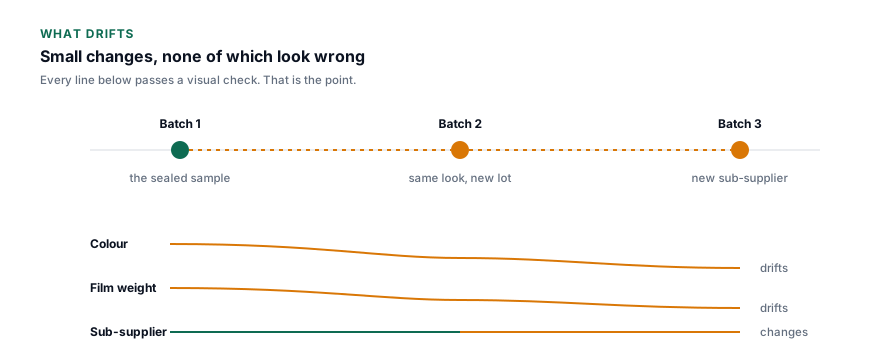
You don't — unless you contracted for notification and for records that make the change visible. This is the most common downgrade and the hardest to find afterwards. Five grams per square metre lighter, a thinner PE layer, a different adhesive grade, a new ink supplier: the appearance does not change, and the seal strength, barrier and residue do.
What to put in the contract, as one clause:
- A list of changes that must be declared and approved in writing before production: different material grade, different resin, adhesive or ink supplier, a new source of substrate, lower grammage, changed process parameters, subcontracted operations, a different production site.
- "Verbal approval is not valid or effective."
- The obligation extends to the factory's own suppliers.
This is not my invention. It is how automotive supply chains have worked for years: one major supplier's manual requires written approval before any such change, states expressly that verbal approval requests are not valid, and applies the same rule down the supply chain. One car maker requires change requests at least 12 weeks before introduction. Packaging has no such tradition — which is exactly why it has to be written in.
Three ways I verify rather than trust: incoming-material and batch records; the grade on the material certificate against the grade in your specification; and scheduled weight and thickness checks on the film — plus targeted testing when the numbers look wrong.
What I can't promise: I cannot guarantee that a factory does not substitute. A normal pre-shipment inspection structurally cannot catch it — in one documented Chinese case the appearance, dimensions and printing all passed while the solvent residue failed. And a supplier holding an ISO 9001 certificate proves nothing about a batch: ISO itself says a company cannot be certified by ISO.
Q40If I sign a quality agreement with a Chinese supplier, what actually happens when I need to enforce it?
Signing is the easy part. Three things decide whether the agreement is worth anything:
- Where the dispute is heard. A domestic arbitration award in China can be refused enforcement for reasons that would not apply to a foreign-related or foreign award — insufficient evidence to enforce, or a finding that the law was wrongly applied. The forum you chose changes your options before the dispute even starts.
- Whether the supplier has assets. On the evidence I have read, the most common reason an award is never enforced — in China or anywhere else — is that there is nothing to enforce against.
- Whether the cost is proportionate. The smaller the claim, the more fees, translation and time eat the recovery.
That is why the effort belongs before the dispute, not after: a sealed golden sample, a written batch-consistency specification, a change-notification clause, inspection records, and payment terms that hold something back until the goods pass.
What I can't promise: I do not litigate, I do not collect debts, and I do not promise that an agreement will be honoured. One source I rely on here is a law firm analysis from 2011 — the structural point about assets still holds, but treat the specifics as needing a fresh legal check. And do not assume the UN Convention on Contracts for the International Sale of Goods applies to you automatically: the UK is not a contracting state, and whether it applies depends on the governing law you chose.
Q41What should I keep from the first order — and can we each seal a copy of the approved sample?
Keep more than you think, and keep it properly.
From the first commercial batch — not the development sample — keep a sealed, signed and dated unit for each party, plus:
- The batch number, printed or labelled on the carton or bag, matching your PO one-to-one.
- The measured values of the key characteristics for that batch: absolute L*a*b* values, grammage, thickness, seal strength, residue, barrier.
- Photographs of the sealed unit with its label, the date and an ID.
- The approval email or chat thread that established the standard.
Storage matters: dark, dry, sealed, labelled, away from a window. A retained unit that has spent a year in sunlight is not evidence of what left the factory.
Do not use one unusually good unit from the first batch and one visibly poor unit from a reorder to represent both shipments. And while a new batch is awaiting acceptance or under investigation, keep the old stock physically separate.
What I can't promise: a retained unit does not replace a written specification, and it does not prove a defect rate. It shows what you approved and what arrived — that is its job.
Q42Which test items should I put in my PO — the ones that actually fail in Chinese spot checks?
Start from the failures, not from a catalogue of tests. China's national spot-check notices are public, and the pattern in films and bags is consistent: barrier performance (oxygen and water vapour), solvent residue (total and benzene series), and seal strength.
- 2023: of 169 composite film and bag batches sampled, 7 failed — 4 on total solvent residue, 3 on oxygen barrier, 1 on water-vapour barrier.
- 2024: among non-composite film bags sampled, 8 failed on oxygen barrier and 2 on water-vapour barrier; in composite film bags, 1 failed on total solvent residue.
- 2025: of 33 cling-film batches, 5 failed on oxygen barrier and 3 on water-vapour barrier.
So a practical PO annex for flexible packaging covers: solvent residue (total and benzene series), oxygen and water-vapour barrier, seal strength, grammage, thickness and material structure, and colour. Each line needs the standard number, the unit, the limit and the test conditions.
Two caveats that matter. First, a Chinese recommended standard is not law until you make it contractual — it becomes binding between the parties when it is agreed into the contract. Second, the tolerance in a standard may be looser than your brand needs: the point of the annex is your limit, not the national one.
What I can't promise: I cannot tell you the minimum legal test set for your product and market without checking your specific use, and I do not quote test prices. I define the scope and get live quotes. I also have not verified the GB/T 10004-2008 text myself — the widely quoted change (total solvent residue from ≤10 to ≤5.0 mg/m², benzene series to "not detected") comes from industry reporting, so check it against the standard before you put a number in a contract.
Still unsure about something?
Ask me directly. I answer within 24 hours, and I will tell you if the answer is "I do not know" or "that is not something I do."